Hikes in Skjerdingsdalen

Skjerdingsdalssetra. Glæra in the background

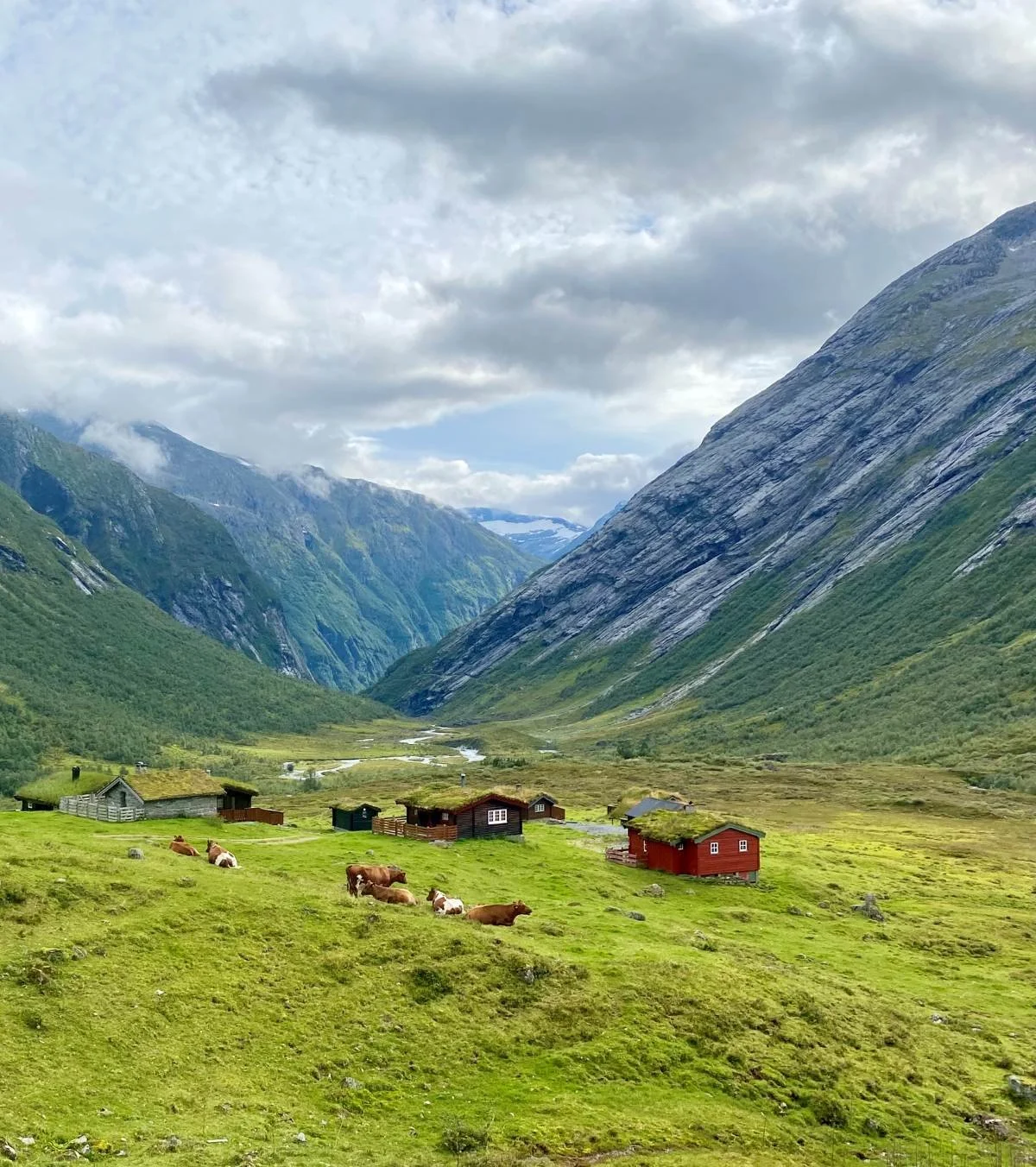
Skjerdingsdalssetra is idyllically located right next to National Road 15 between the Ospeli Tunnel and the Grasdal Tunnel. Today it is possible to drive to the summer farm, but before the new road across Strynefjellet was completed in 1978, the farm road passed the steep mountain section known as Glæra. The landscape here is dramatic, and many animals have unfortunately ended up in the ravine.

The old summer farm road branched off from the main road by the impressive Jøl Bridge, and from there it is about a 4.5-kilometre walk to the summer farm.

Unfortunately, the road is currently closed due to a rockslide in Glæra. Reopening the road is difficult and costly work, so it may take time. Nevertheless, we include a description of this hike.

Download PDF with hike description

Description of the hike

The almost 5 km long hike between Jøl Bridge and Skjerdingsdalen can be walked in both directions. The starting point is either Jøl Bridge or Skjerdingsdalssetra, which lies at about 600 metres above sea level, slightly above where the rivers Skjerdingsdøla and Grasdøla meet. National Road 15, opened to traffic in 1978, passes close by the summer farm.

In this description, the hike starts at the impressive Jøl Bridge, a stone arch bridge from 1883 that was a prerequisite for the construction of the old Strynefjell Road. Beneath the bridge, the river Skjerdingsdøla flows on its way from Skjerdingsdalen to Hjelledalen. From the bridge, the summer farm path climbs steeply up Åsen on the western side of Skjerdingsdøla.

Jøl Bridge from 1883

The gorge seen from the bridge, almost 60 metres deep

On the right-hand side of the path as you climb the first slope are the remains of a guard hut from the Second World War. It was built by the Germans, who maintained a 24-hour guard duty here to prevent sabotage of Jøl Bridge, which was strategically important for the connection between Eastern and Western Norway.

Remains of the German guard hut

Further up lies Smørsteinen (the Butter Stone), which was a resting place for people who in earlier times transported dairy products home from the summer farm. Farther on, you pass Åseledet, where there used to be a fence and a gate to prevent livestock grazing in the Skåre outfields from making their way up to the summer farm on their own.

On the other side of the river lies Ospelida, where a fugitive is said to have lived in the past (probably in the 15th century). There are clear traces of building foundations on the mountainside, which has very steep access and is only accessible to those familiar with the terrain.

The summer farm path after it was recently cleared

After a while, the path makes a sharp 90-degree turn when crossing Styggejølet and then levels out before a slight downhill stretch over Urene. A large snowdrift often forms over the trail here, which can remain well into summer, but it is usually passable.

The path then crosses a large stream and climbs a rocky scree before reaching Selebotsvodene, where the trail changes character and eventually passes through a forest of mountain birch.

Below a large rock higher up on the left-hand side lies the “Brennevinsgrova” (Brandy Cave), which in earlier times provided access to cold spring water for travelers. In recent years, the water has likely found new courses, as little remains today.

The trail continues through the mountain birch forest, and before ascending the steep Glærebakken, you can see the even steeper Bukkehamnen on the other side of the gorge. The name probably originates from the time when goats grazed on the summer farm.

The path winds through a dramatic and fascinating landscape, with the gorge under Glæra lying about 200 metres below the trail. After passing Glæra, you reach the remains of Glæreledet (a gate), which marked the boundary between the outfields of Skåre and Skjerdingsdalssetra.

Glæra with smooth rock slabs both above and below the path.

A rockslide blocks the path through Glæra. It is not safe to pass here.

Skjerdingsdalssetra seen from Glæra

The waterfall where Skjerdingsdøla plunges into the gorge

Tjønnhojen

On the way to the summer farm, you pass Tjønnhojen, a terminal moraine formed by countless similar landslides that cleared the mountainside above of loose material and deposited it in the same spot.

Geitekloppa

It is not far to walk from Tjønnhogjen to Geitekloppa, where you can cross Skjerdingsdøla on a simple wire bridge. A basic wooden deck is removed before winter and replaced in the spring. From there, it is a short walk of just under a kilometre to the summer farm.

A new sturdy bridge with steel beams a little further into the valley

Skjerdingsdalssetra is idyllically situated on a small ridge. We are looking toward Glæra.

The summer farm seen from
National Road 15

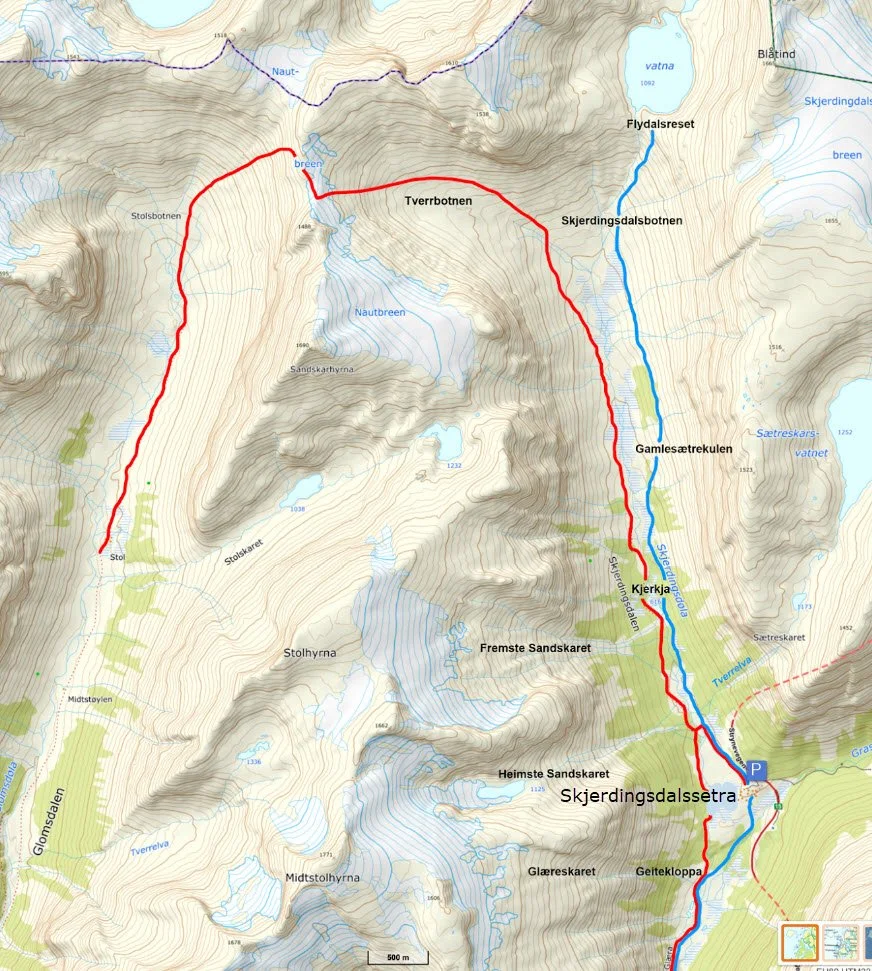
Hike into Skjerdingsdalen to Skjerdingsdalsbotnen, or optionally up to Flydalsreset

There is a trail from Skjerdingsdalssetra on the east side of Skjerdingsdøla leading into Skjerdingsdalsbotnen, a hike of about 6 km.

We can see the small bridge over Tverrelva. Tverrelva flows down from Setreskaret and can be quite large at times.

The route to Flydalsreset is marked in blue on the map. The route over Nautebreen to Stol is marked in red.

Kyrkja (The church) in winter attire

After walking about 2.5 kilometres into the valley, you reach a large upright-standing rock known as Kyrkja. Further in lies Gamle Seterkulen (about 700 metres above sea level), where the summer farm was located before the farm road through Glæra was established. Depressions in the terrain show traces of old summer farm buildings. The trail continues into Skjerdingsdalsbotnen.

It is also possible to continue the hike up to Flydalsreset, which lies just under 1500 metres above sea level. On the plateau there is a small lake, and at the far end you can look down into Flydalen in Geiranger. The descent there is steep and difficult, and it is safest to go with proper safety equipment.

View into the valley

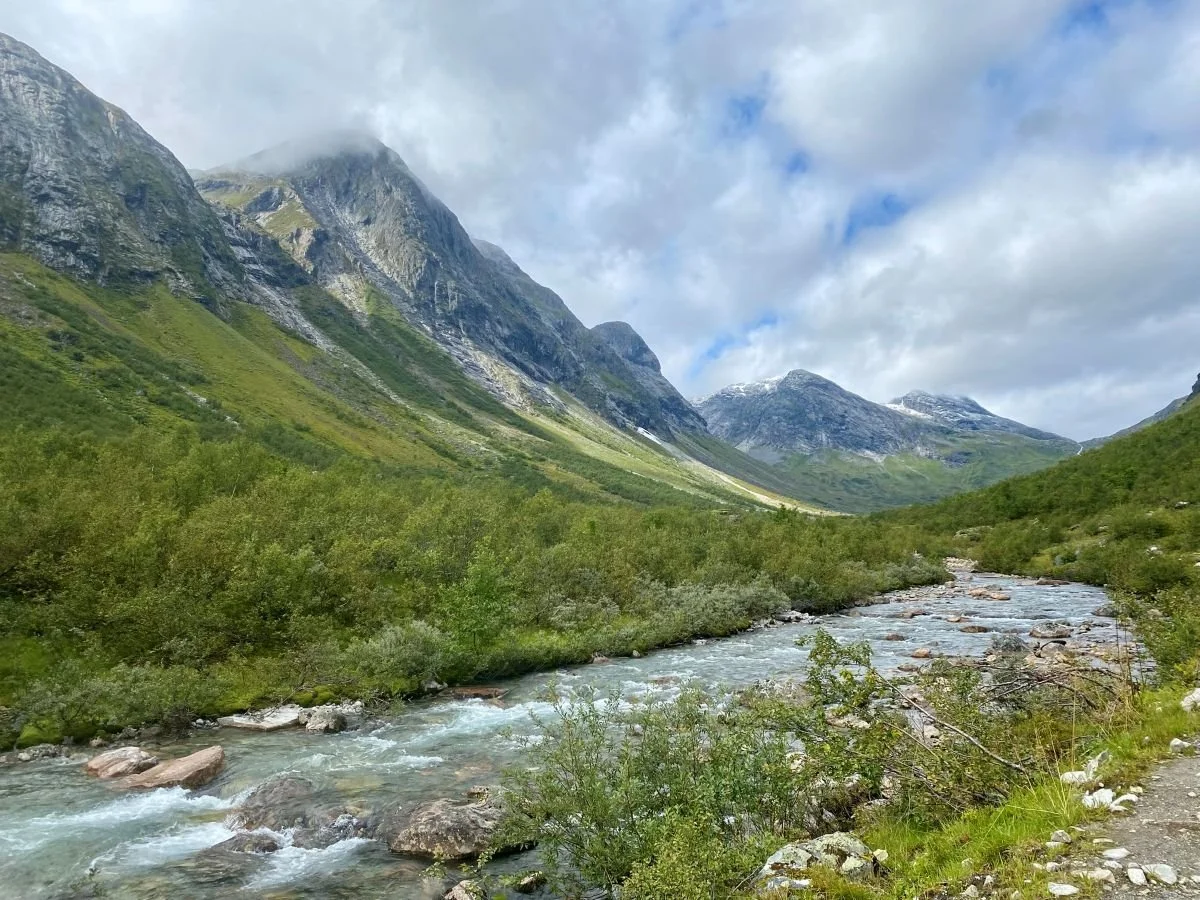
The trail toward Skjerdingsdalsbotnen follows the river for long stretches. In the photo above, we see Flydalsreset at the far end of the valley on the right-hand edge of the image. At the back of the valley to the left, we can see Tverrbotnen, which leads up to Nautebreen. The characteristic mountain ridge on the west side of the valley resembles the old tool called a skjerding, hence the name Skjerdingsdalen.

Hike into Skjerdingsdalen to Nautebreen and optionally over into Glomsdalen

For this hike, it is best to take the trail on the west side of Skjerdingsdøla from the bridge at the mouth of Tverrelva. Alternatively, you can follow the trail on the east side, but depending on the water flow, this may require wading the river far into the valley.

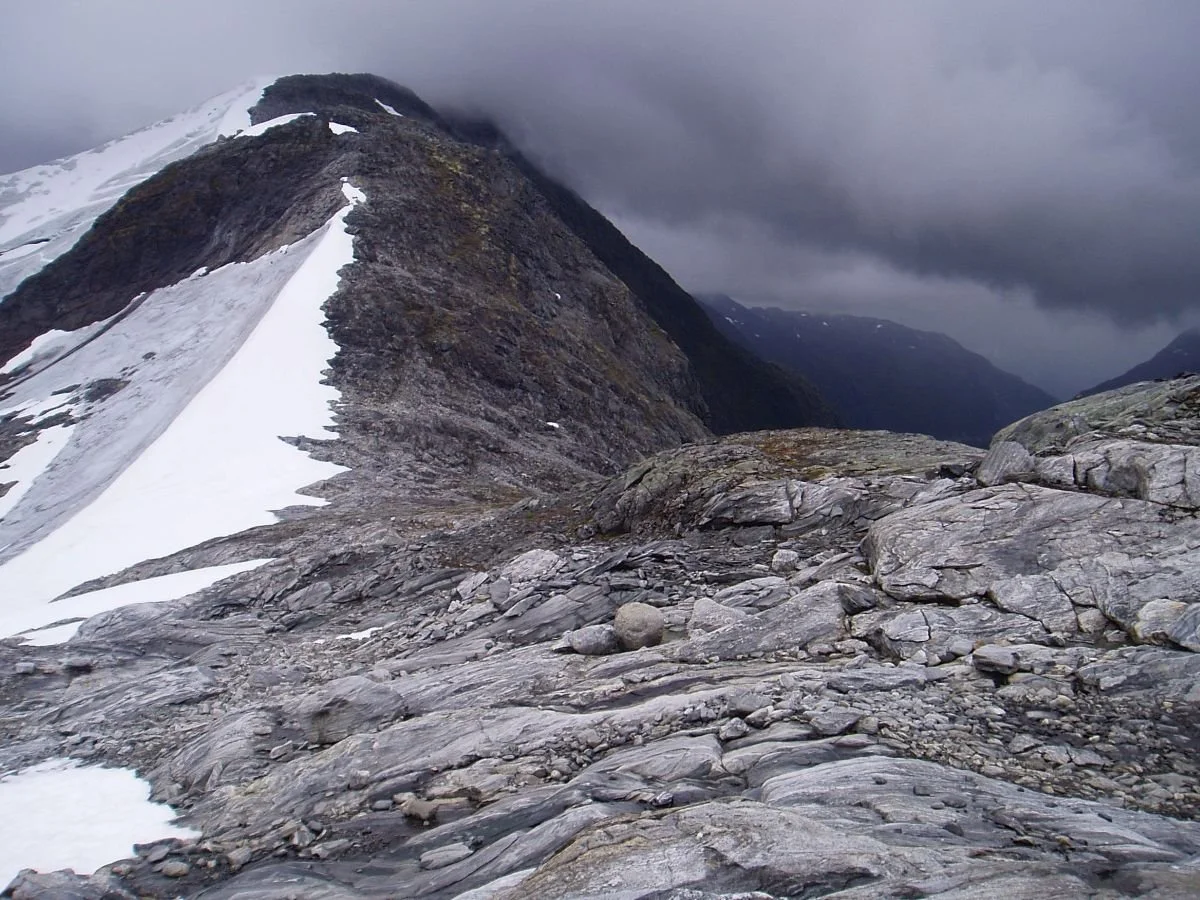
The trail on the west side is not always clearly marked. Farther into the valley, the path turns to the left, leading up to the plateau called Tverrbotnen, where there is also a small, shallow lake. For the onward hike, it is advisable to stay to the right on the ridge between Skjerdingsdalen and Glomsdalen. The pass between Skjerdingsdalsbotnen and Glomsdalen lies at about 1500 metres above sea level. This is where Nautebreen used to be, but in recent years the glacier has melted due to warmer climate.

If you want to continue into Glomsdalen, it is important to stay to the right on the ridge, entering Glomsdalen as far as possible before descending steeply toward the bottom of the valley.

History

Skjerdingsdalen is a fertile summer farm valley that was in earlier times difficult to access, located in the mountains northeast of Oppstryn, with one arm stretching toward Geiranger and another toward Grasdalen and Skjåk.

It is an old summer farm valley, likely in use during the 15th and 16th centuries, but abandoned in the early 1700s due to significant climate changes that led to the growth of glacier arms.

At the autumn assembly in Stryn on 16 October 1730, the authorities announced the following:

"As everyone knows, several farmers in Grov, Guddal, and Skåre in earlier times had summer pastures in the fertile Skjerdingsdalen. For a long time, this summer farming has been abandoned. In order for this fertile valley not to lie unused, but to be put to use as in earlier times, it is hereby announced that all who wish to help establish the road through Tystigen and make use of the valley shall, for the future, own and use the valley with its forest, land, and all its resources."

Originally, 13 farmers became owners, but many more have joined over time, including from Strandsida. Today, farms from Skåre, Grov, Grønfur, Mork, Dårflot, and Fosnes have summer farms here. After a legal ruling in 1988, there are now a total of 37 co-owners, most with small shares and without active farming. The number of farms with livestock in the summer farm has declined over the past decade.

In earlier times, reaching Skjerdingsdalen was challenging. The original route likely ran from Tystigen via Grasdalen to Skjerdingsdalen. When the summer farm was revived after 1730, the farm road ran from Glomnesstranda, through the entire Glomsdalen (about 10 km), over Nautebreen, and down into Skjerdingsdalen. At that time, the summer farm lay halfway down Skjerdingsdalen at Gamle Seterkulen, about a kilometre further into the valley than the large rock called Kyrkja.

The long and arduous farm road took a couple of days for those coming from both Hjelledalen and Strandsida. In 1851, on the way home, bad weather and storms over Nautebreen caused so much trouble that 20 of the best dairy cows were left on the glacier, making a new farm route urgently needed. The following year, work began to level and improve the trail through Glæra, so that it became possible to bring the livestock through. Before that, people managed to pass it only using ropes.

The farm road through Glæra was completed in 1853. Dynamite had not yet been invented (it came in 1866), so they used rough drill holes and blasting powder to carve a ledge barely 100 metres through the mountain. The road was about 1 metre wide. At the same time, the summer farm was moved from a few kilometres further into Skjerdingsdalen down to its current location, where Skjerdingsdalen and Grasdalen meet. Better access led to increasingly intensive use of the valley. Activity peaked in the late 19th and early 20th centuries, with cattle, sheep, goats, pigs, and horses. For a period, there was even a small dairy at the summer farm.

The Glæra trail damaged by a rockslide in 2022

During the severe unemployment of the 1930s, state employment grants were allocated for improvements to the road through Glæra. Work did not begin until after the war, but then the road was widened to about 2 metres, levelled, and made safer for both people and livestock. The work was completed in 1948. From that time, volunteer work was carried out every spring on the road from Jøl Bridge to Skjerdingsdalen to maintain the summer farm path and clear snowdrifts and rockfalls.

Much changed after the construction of the all-year road over Strynefjellet. National Road 15 opened in 1978. Since then, all cattle and most small livestock have been transported to and from Skjerdingsdalssetra by tractor or car. The farm at Skåre continued to use the summer farm road for sheep for another 40 years.

Later, the summer farm road through Glæra has become primarily enjoyed by off-piste cyclists and hikers.

With changing climate and increasing rockfalls on the mountainside through Glæra, it is no longer safe to pass there during periods of heavy rainfall. After a large boulder blocked the trail through Glæra in 2022, the summer farm owners have taken action to secure funding for the restoration of this unique cultural heritage—the summer farm road to Skjerdingsdalen. Until necessary measures are taken, warning signs have been put up advising against passing through Glæra.

It is still possible to take the hike from either side without going through Glæra itself.

Natural Landscape and Botany

Skjerdingsdalen is part of a comprehensive glaciological environment, where processes and deposits from the post-glacial melt period after the last Ice Age (approximately 1500–1920) up to the present are particularly instructive. Near the confluence of Skjerdingsdøla and Grasdøla, there is an impressive landslide embankment with water in the associated landslide depression. A prominent lateral moraine at Skjerdingsdalssetra was partially destroyed during earthworks when National Road 15 was constructed.

The deep gorge below Glæra extends all the way down to Hjelledalen and is a clear result of erosion from glacial rivers during the post-glacial period.

In Skjerdingsdalen and Grasdalen, there are steep mountainsides with high landslide activity. For this reason, in 1982 the board of the Skjerdingsdalen co-ownership entered into an agreement with the Norwegian Geotechnical Institute to establish a research embankment (a brake embankment) in Ryggfonna, located at the western end of Grasdalen. Measurements of speed, pressure, etc., provide a basis for advising on the construction of avalanche protection structures elsewhere, considering size, load, and pressure.

The vegetation along Skjerdingsdøla through Glæra was mapped in the early 1980s in connection with plans for hydroelectric development in Breheimen. The study documented significant botanical values, including particularly rich plant diversity and special vegetation shaped by the river and waterfall landscape. Due to the moist and cool climate in the gorge, plants that normally grow in other geographic areas thrive here.

Text and photos: Berit Wetlesen and Jørgen Skåre, 2025